Friday, November 18, 2011
Football cadence in a noisy stadium

Tuesday, June 8, 2010
Optimal PhD core exam implementation
Saturday, April 24, 2010
Eagles draft a Northwesterner

Thursday, April 22, 2010
The role of agents in the NFL draft game
It took me a little while to reconcile why this doesn't happen. Top picks in the draft are generally believed to be overpaid in comparison to what they would be paid in a free agency model. This must mean that the players have much more power than the teams, especially for early draft picks. I resolved this by realizing that the role of agents is more than just understanding the legal intricacies of the contracts. Agents, and the agency problem that ensues, are used by college players entering the draft as a commitment device to reject low offers.
Suppose that Sam Bradford, the consensus number one pick this year had no agent. He would be picked first by the St. Louis Rams, but both the Rams and Bradford would know that if Bradford did not sign, he would have to enter the draft again next year, and after a year of not playing, he would be drafted much lower, maybe at the 10th pick. Suppose the 10th pick usually gets paid half as much as the first pick. Bradford can not credibly threaten not to sign for a low amount if it is higher than what he would get had he been drafted at number 10. The teams can credibly threaten not to raise their offer since they are in a repeated game with draft picks every year, while Bradford is in a single shot game.
But the agents change the game. The agents have an agency problem, which actually serves to benefit the player. While the player can not credibly threaten to not accept an offer higher than his reservation wage, the agent can credibly threaten not to accept an offer higher than the player's reservation wage. This is because the agent is also in a repeated game. If Sam Bradford's agent accepts a deal which is 20% lower than the deal the first pick got last year, he will never work again. So teams know that the agent needs to get a decent deal (relative to past deals).
If the teams try to lowball the offer and the agent refuses and the player enters the draft the next year, this is very bad for the player, but it is not very bad for the agent. The agent gains a reputation for refusing lowball offers, which makes him even more likely to be hired by future college players.
In an ultimatum game setting, suppose the person receiving the offer was allowed to hire an agent to make his decisions and that this agent was a public figure with a reputation. Which agents would be most desirable from the receiver's perspective? They would be the agents who have a reputation for rejecting any offer less than 95% of the total pool. This threat is credible to the person making the offer in the ultimatum game since the agent has a reputation that is valuable to him and would be destroyed by accepting a low offer. So the ability of players in the ultimatum game to hire publicly known agents completely reverses the power each player has in the game, and shifts the rational equilibrium from the offering player extracting most of the surplus to the receiving player extracting most of the surplus. The agents, and the agency problem, act as a commitment device which benefits the players hiring the agents.
Tuesday, April 13, 2010
Did H1N1 save lives?
Sunday, January 31, 2010
Strip iterated prisoner's dilemma
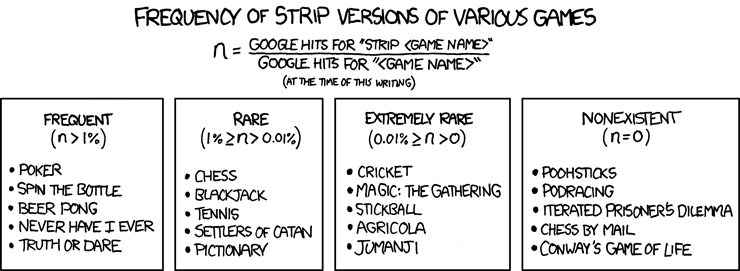
(Image courtesy of xkcd, click for larger image)
Saturday, January 30, 2010
Quote of the week
On why Ricardian Equivalence (the concept that the timing of taxes does not impact consumer choices i.e. it doesn't matter if you finance government spending with taxes today or taxes tomorrow) might fail in the real world:
"People could be retards...sorry I'm not supposed to say that."
Monday, January 25, 2010
My own selfish altruism
Monday, January 11, 2010
Quote of the week
-my Macroeconomics professor during the first class this quarter
Friday, January 8, 2010
My budget, aerial acrobatics

Tuesday, January 5, 2010
Friday, January 1, 2010
Quote of the week
Tuesday, December 22, 2009
Innovative marketing
Sunday, December 13, 2009
Religion, Science, Fear, Reason, and Turbulence
I was reading The Extended Phenotype, a book about evolution, by Richard Dawkins, a near militant atheist, on the plane ride to Philly. The guy next to me was reading the bible. At one point there was some turbulence, and it felt like near free fall for a second or two. I had my head down at the time, and noticed him jolt and grab the arm rests. I looked up and sort of grinned and he asked if I knew that was going to happen. I said no, it’s just turbulence.
I did not have a natural fear reaction like he did. My natural reaction was there must be some reason and everything will be ok. I think it may be because my conscious mind when it goes on a plane somehow turns off fear signals from the unconscious, but I’m not sure. But given our choices of reading material for the flight, I thought about a more interesting question: Are religious people more fearful than scientifically minded people? Is there causation in either direction? One purpose of religion seems to be to relieve people of fears about uncertainty in life (“God has a plan for me”, etc.). Are fearful people then drawn more to religion? My reaction of “there must be a reason for this” could certainly come from scientifically minded indoctrination, but also maybe I’m drawn to scientific thinking because I’m drawn to reason.
Thursday, December 10, 2009

Tuesday, December 8, 2009
Precipitation map of Chicago

Monday, December 7, 2009
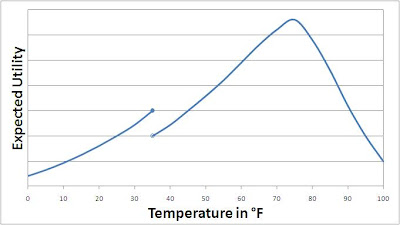
Expected Utility by Temperature
Saturday, December 5, 2009
Thursday, December 3, 2009
My budget


I am slightly concerned about the eating out and drinking categories. In both October and November I was over budget in the categories. The reason I hesitate raising the budgets is that both of those categories in both October and November were characterized by under budget spending for 90% of the month, and then way over budget spending for 1 weekend each month when I had friends visiting. In October I spent just over $100 on eating out and drinking in the last 2 days of the month when I had visitors, compromising about half of my spending that month on those categories. In November I spent $85 on eating out and drinking over 3 days when I had visitors.
I don’t think I will have visitors this frequently in the future, so I am not raising the budget yet. I’d also like to try to spend less even when I do have visitors. December is not going to be an informative month because I will not be in Chicago for half of it, but January and February should be more like typical months. I will probably wait until the end of February when I will have 6 months of expenses recorded to adjust my budget further. I suspect I will be able to decrease the groceries budget by $20 or $30.
Wednesday, December 2, 2009
My first act as president
I'm sure there are those of you who believe that markets are perfect and hence we need only make clear umbrellas an option. However, empirical evidence, as well as theory suggests this is incorrect in the umbrella market. First of all, clear umbrellas are already available and we do not see everyone carrying around clear umbrellas. Secondly, there is a stigma attached to clear umbrellas that imposes a social cost to males who use a clear umbrella. This stigma should be removed.
Theoretically, a situation in which everyone carries a clear umbrella can not be a Nash equilibrium, because an individual would be better off carrying an opaque umbrella which would act as a credible threat. The rest of the people with clear umbrellas would avoid the opaque umbrella, and the opaque umbrella would bare none of the costs of avoiding sidewalk crashes. Empirical evidence shows that nearly everyone carrying an opaque umbrella is a stable equilibrium, and my intuition tells me that almost everyone carrying a clear umbrella would not be a stable equilibrium, if an equilibrium at all.
Since the social optimum can not exist in equilibrium, it is the government's responsibility to impose laws which send us to the social optimum, and as president, I would pledge to do so.